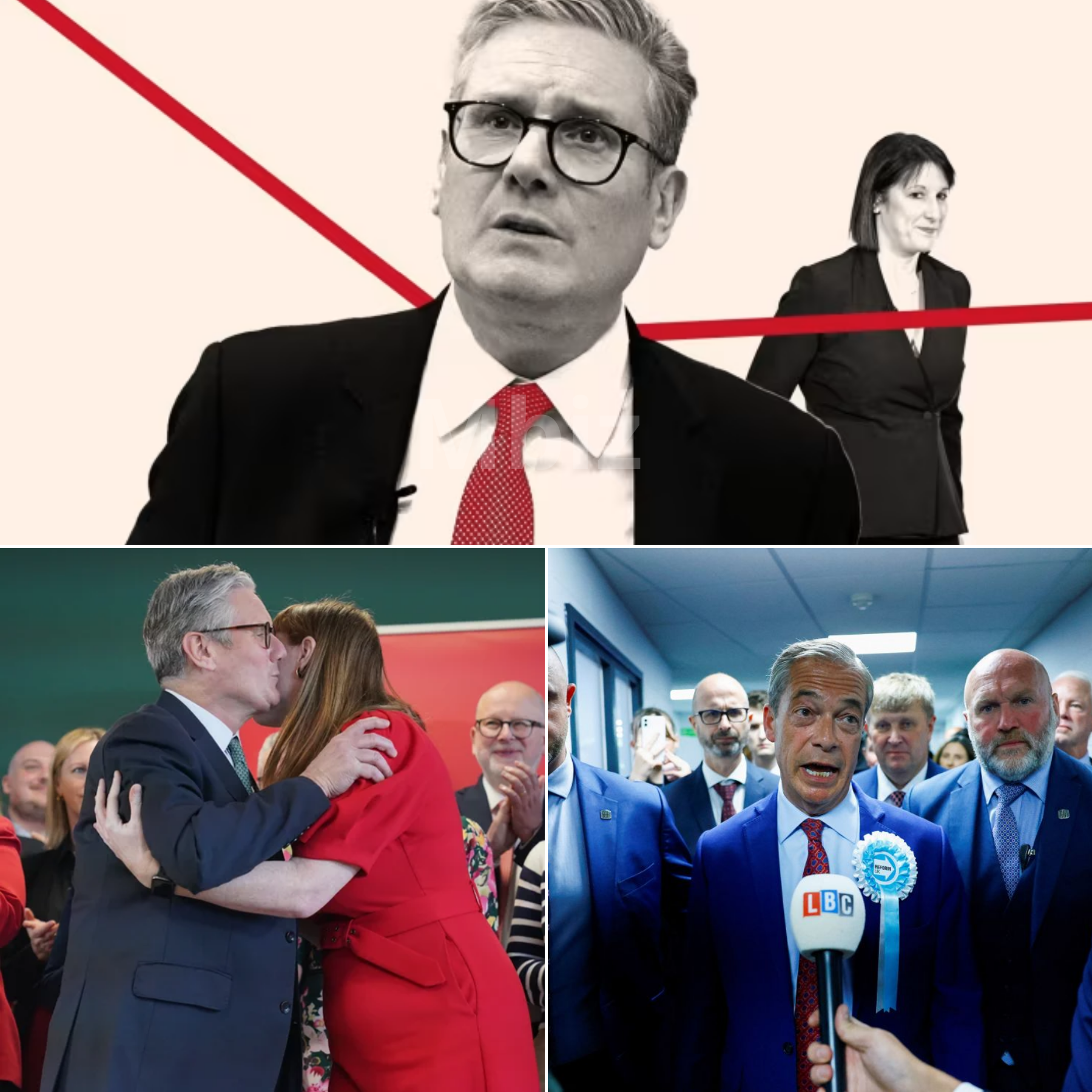
Sir Keir Starmer was quick to jump on claims Nigel Farage used anti-Semitic and racist language when he was at school.
After the Guardian reported a dossier of lurid complaints from more than 40 years ago, the Prime Minister insisted the Reform leader needed to urgently ‘explain the comments, or alleged comments’.
The claims made by more than a dozen former classmates of Mr Farage at Dulwich College in South London – which he strongly denies – are deeply unpleasant.
One Jewish contemporary described how the 13-year-old Farage ‘would sidle up to me and growl: “Hitler was right” or “gas them”, sometimes adding a long hiss to simulate the sound of the gas showers’.
Another ethnic-minority pupil claimed that when he was about nine and Farage 17, the future politician would ask ‘where I was from’, before pointing away and saying: ‘That’s the way back.’
As more pupils have come forward with similar stories and the furore has grown, other senior Labour figures have followed Sir Keir’s lead. Attorney General Richard Hermer, a senior Jewish minister, said last week that Mr Farage ‘clearly deeply hurt’ many people with his alleged behaviour.
While the concerns about Mr Farage’s suspected teenage comments are clearly understandable, the Prime Minister’s decision to get involved in a row about what a rival politician allegedly did at school in the late Seventies and early Eighties inevitably invites scrutiny of his own youth.
And, as a Mail on Sunday investigation reveals, Sir Keir faces a few uncomfortable questions.

23-year-old Keir Starmer pictured in his visa to join a youth work camp in Communist Czechoslovakia

The visa was discovered by the Mail in the ‘Foreign Intelligence Main Directorate -Operative Files’
Most extraordinarily, we found that a young Starmer was a driving force behind an ultra-Left publication that backed a campaign to free a convicted Marxist terror chief – and may have become a tool, unwitting or otherwise, of the KGB propaganda machine.
Not that you would know any of this from the man himself, despite Starmer putting his upbringing at the heart of his pitch to become Prime Minister.
He launched his General Election campaign with a vivid description of his working-class youth in the Surrey town of Oxted.
He proudly described how, despite the hardships, he became the first member of his family to attend university after he won a place to study law at Leeds.
Sir Keir, however, has been rather quieter about the time that immediately followed his days as an undergraduate.
Those formative years in his mid to late-20s, when he was a postgraduate student at Oxford and a trainee barrister in London, have hardly warranted a mention.
Last year offered a possible clue to that reticence, when the Daily Mail revealed the astonishing story of how, in 1986, just before his 24th birthday, Starmer travelled to Czechoslovakia to join an international work camp to restore a memorial to victims of a Nazi atrocity. It was a visit monitored by Communist spies.
Unbeknown to Starmer and other overseas volunteers, such camps were part of long-term and wide-ranging operation by the nation’s secret police force, StB.

In 1986 , Starmer and a small group of friends launched a magazine called Socialist Alternatives, just a few weeks before crossing into Czechoslovakia to join his work camp
Declassified Cold War security service files in Prague about other camps show the aim was to undermine Nato by identifying young high-fliers for potential future ‘exploration’ and use.
Security experts have suggested that Starmer’s only mistake on this occasion was youthful naivete in signing up to a venture run by a totalitarian Communist regime.
But the MoS can reveal this was by no means the only time the future Labour leader brushed up against troubling influences during a period when, according to one contemporary, his politics were nakedly ‘hard-Left’.
It centres around a magazine called Socialist Alternatives, which was launched by Starmer and a small group of friends in 1986, just a few weeks before he crossed into Czechoslovakia to join his work camp.
The publication was the brainchild of Benjamin Schoendorff, a charismatic Frenchman whom Sir Keir had met at the Oxford University Labour Club. Schoendorff was well connected in Marxist circles and arranged for the magazine to be fully funded by the Paris-based International Revolutionary Marxist Tendency.
The obscure Left-wing faction – who were known as Pabloists after the founder’s nickname – wanted to broaden socialism to include feminism and green politics and this found expression in Socialist Alternatives.
Mr Schoendorff has previously declined to speak to Sir Keir’s two biographers and did not respond to our requests for comment.
But in an online talk to the London Socialist Historians last year, he recalled how he and Sir Keir had been ‘radical anti-imperialist eco-socialists’. Schoendorff told the audience he first encountered Starmer outside the University Labour Club meetings.
And he suggested that Starmer had rapidly accepted his invitation to join his Marxist Pabloists sect and soon became one of his ‘closest comrades’.
‘There is something strange about Keir in general,’ Schoendorff told the London meeting.
‘Normally when you recruit someone… it takes a while. You need to go through lots of stuff. I have no recollection of doing this with him, so that’s kind of strange.’
Starmer played a key role in Socialist Alternatives as the magazine launched just as he was finishing at Oxford. Officially, Starmer was one of the ‘editorial collective’ comprising a small group of fellow students or recent graduates.
But Richard Barbrook, an unpaid contributor, has said that while Schoendorff was the leader, it was Starmer ‘who got the magazine done’.
He got all the articles in, laid the pages out, delivered it to the printers then collected and distributed it at bookshops, he said. ‘The magazine wouldn’t have existed without him.’
Socialist Alternatives criticised the Labour Party under Neil Kinnock – which voters eventually rejected at the 1992 Election – for being nowhere near Left-wing enough.
Its editorials called for a ‘radical extension of common ownership over wealth and power’ and argued that ‘prisoners should have much greater control over the conditions of their own imprisonment’.
Starmer’s bylined articles variously attacked ‘the authoritarian onslaught of Thatcherism’ and called for a ‘nationwide campaign of struggles’ to reduce the European working week to 35 hours.
He also lambasted the police for their conduct during the 1986 Wapping industrial dispute between print workers and Rupert Murdoch’s newspaper empire.
Denouncing ‘paramilitary policing methods’, Starmer said the clashes between officers and union workers led ‘to the question of the role the police should play, if any’ in civil society. ‘Who are they protecting and from what?’ he demanded.
Another intriguing article, penned by two of Starmer’s co-editors, is a stern critique of the British and Western ‘media hysteria’ over the devastating explosion at the Chernobyl nuclear plant three months earlier.
Headlined with the Russian ‘Katastropha’, it mocked Western superiority over the disaster, pointing out that there had already been grave accidents at the Three Mile Island plant in Pennsylvania and Windscale on the Cumbrian coast.
‘The evidence from the West shows that we are no better,’ insisted the article. It also accused the West of being ‘hypocritical’ for attacking the Soviet’s secrecy over Chernobyl, claiming the US and British nuclear industries were also ‘deeply secretive’ and ‘highly centralised’.
It is an article that – fairly – raises questions as to whether the magazine had been duped into becoming a tool of Soviet propaganda. Neither of the authors of the Socialist Alternatives article responded to an MoS request for comment.
It is not known how the bizarre text came to be written – which is relevant because of one remarkable coincidence: the Mail has discovered that, one month before its publication in July 1986, Moscow launched a secret push to ‘paralyse’ criticism of Chernobyl.
The point was to encourage Western media outlets to write stories highlighting their own nuclear accidents, instead of focusing on a Soviet disaster.
A summary of the KGB’s Operation Graphite found in the Czech state security service archives explains: ‘The aim was to defy and paralyse the enemy campaign against the USSR and other countries of the socialist bloc in relation to the Chernobyl nuclear disaster.’
The declassified files show that the KGB pushed disinformation dossiers together with key propaganda lines and instructions on how to promote these among sympathetic journalists and other officials in the West.
It involved ‘pointing to similar events that had occurred in the past’ in the West, including ‘accidents in nuclear power plants’ and repeating allegations that Western authorities had responded with secrecy.
These dossiers were sent to Russian and other Soviet Bloc diplomats and secret collaborators working in the West.
The London Czechoslovak embassy was ‘involved in the preparation and implantation’ of the operation in the UK. Embassies in Paris were also engaged to spread the KGB disinformation.
The Czech files say the Soviet message was ‘spread verbally in diplomatic, business, political and journalistic circles’, that it had ‘contributed to the paralysis of the West’s enemy campaign against the USSR’ and had also ‘diverted public attention throughout the world’.
The following year, Socialist Alternatives ran an appeal from a group called the ‘Justice for Otelo Committee’. This referred to Otelo de Carvalho, a Portuguese brigadier who was later jailed for his role as a leader of FP-25, a far-Left terrorist group that carried out armed assaults, kidnappings, robberies and bombings, which left at least 14 dead and many wounded.
The group had fired rockets at the Royal British Club in Lisbon – in solidarity with the IRA – and at the British Airways office in Porto.
Supporters of Otelo put their name to a Socialist Alternatives appeal against the sentence, which claimed his trial had been ‘remarkable for its grave irregularities’.
The signatories included future Left-wing luminaries Jeremy Corbyn, Tony Benn, Clare Short and US academic Noam Chomsky. It concluded with a note urging others who supported the campaign to write to an address in Archway Road, North London, which Sir Keir shared with several others also involved with the magazine and where editorial meetings often took place. Despite the efforts of his British supporters, Carvalho served five years in jail.
Asked about the articles, a Labour Party spokesman stressed that in his later role as Director of Public Prosecutions, Starmer ‘faced down the threat of international terrorism’ by ‘locking up 150 terrorists’, including the first ever conviction of an Al-Qaeda ringleader as well as the ‘liquid bomb plotters’ who tried to carry out a British 9/11.
But when speaking for himself, Starmer has appeared a little less ‘on message’ than his spin doctors. He has spent most of his Labour leadership trying to show he has made a clean break with Corbyn’s politics, so you might expect him to dismiss his time at Socialist Alternatives as youthful stupidity. Yet his sympathetic biographer Tom Baldwin says this is not the case. He wrote last year that Sir Keir told him, ‘surprisingly’, that his articles from the time do matter and that ‘what he wrote was part of his evolution and, as such, traces of it can still be found in his DNA’.
Other former comrades take a more downbeat view, notably Schoendorff, who today works as a clinical psychologist in Canada but is still a hardcore socialist and vocal critic of Starmer’s Labour Party on social media.
During the election campaign, he claimed there is ‘no sign’ that Starmer’s radical youth left any trace on his current politics.
‘The guy is an empty suit…’ he said. ‘I think he’s just a puppet saying whatever he’s being told to say and it’s going to be the worst you’ve ever seen.
Every day it seems he’s able to insult our intelligence and morals in a new way, which is beyond comprehension… I don’t think he’s his own person. I think other interests have their hands firmly up his backside.
‘He’s pretty wooden, right? He’s not so inspiring. I don’t think there is anything special about Keir. Maybe I’m missing something.’
For all the efforts of Starmer and the ‘editorial collective’, Socialist Alternatives was a flop. Starmer’s attempts to move the political dial had no lasting impact and the magazine sold only a handful of copies. For all its sound and fury, even its founder Schoendorff conceded: ‘No one read it.’